

Often Hard to Tell from the Original
Why do we call our work a manufactory? Because, just as more than 100 years ago, we make our piano rolls and all accessories largely by hand, or have them made that way. The same applies to digitization. We pack and transport the rolls ourselves, check and scan every single roll by hand and, by arrangement, repair damaged rolls so that they can be digitized and thus preserved. Reviewing and checking the data is also, in a broader sense, the handiwork of specialists. Technical tools are, and will remain, just that: valuable tools.

Every One of Our Rolls Is Unique
All items are modeled on originals. Because so much of the work is done by hand, deviations and production differences can and will occur. If we ever make a mistake and it slips through our spot checks, please simply contact us directly. At the very end of each roll there is a small note with a number and production date, just as Welte used to do.
Like the instruments, boxes and accessories need a constant, constantly monitored room climate (50–60% relative humidity) to protect them from damage caused by dryness or moisture. During the heating season, additional humidification and ventilation are usually needed for both instrument and rolls. Piano rolls must be stored in their box and be neatly rewound. Improper handling or defects in the instrument can damage a roll, and we cannot accept liability for this. Every roll comes with a leaflet with handling instructions. The good news: if a roll ever breaks, you can send it to us. We will recut the title and mount it on the existing spool at a reduced special price. We know from contemporary accounts that even back then, very popular titles in particular showed wear after a while and were simply bought again.

Every Instrument Was and Is Different
Our rolls follow the theoretically correct hole spacing, so they should play well on all instruments of the corresponding type. However, our analyses of various instruments have shown that Welte tracker bars, for example, sometimes differed significantly in spacing and design. Sometimes the holes in the tracker bar, whether made of wood or metal, are of different sizes, which also means that the holes are not covered equally well across the whole tracker bar. This also happens with original Welte rolls. Assuming your instrument works well and is properly regulated, please check the dimensions and spacing of your tracker bar and the alignment of the take-up spool with the roll if problems occur. We can also perforate different spacings or rework rolls by hand if your instrument requires it, although this means additional work per roll. In any case, please let us know if you have problems with our rolls. Of course, we are also happy to hear from you when everything simply works well.

Tempo Is Something Living and Flowing
To this day, experts are trying to find out what the ‘right’ tempo for a piece of music is, as the pianists and composers played it in the original recordings. Gustav Mahler is said to have remarked on tempo: “About the far more important matter, the tempo and indeed the overall conception and structure of a work, very little can be established in this way, for here we are dealing with something living and flowing that can never remain exactly the same, not even twice in a row.” (Summer 1895; Gustav Mahler, Im eigenen Wort, Peter Schifferli Verlags AG “Die Arche”, Zurich.) Welte and Philipps set a fixed ‘normal’ tempo for their reproducing rolls, while Hupfeld and others gave a tempo range for each roll, e.g. ’50–60′. Even so, Welte and Philipps instruments also had a tempo lever to play rolls up to 50% faster or as slowly as desired, depending on personal taste but surely also on how the instruments were doing that day, since they were quite sensitive to changes in the weather or to infrequent use. So-called tempo test rolls make it possible to set the normal tempo quite precisely, yet comparisons of the same piece played by the same pianist on different rolls sometimes show significant differences. Tempo and playing time therefore remain something living and flowing.

Experience and Expertise You Can Hear
Based on the analysis of a great many original rolls and discussions with leading experts, we have set limits for production deviations. Our goal is to keep deviations below the audible range. Even with the original manufacturers, such as Welte, the same title on different copies of a roll sometimes showed clear differences in length and perforation, even on the test rolls that are so important for regulating the instrument. Our recuts are always based on the best original roll available to us. We only correct errors in the digitized roll (e.g. from aging, damage, later corrections, production errors, etc.) if leaving them would significantly affect the expression control (e.g. missing on or off signals). The notes themselves remain unchanged. The photo on the left shows scan excerpts of two Welte copies of the same title laid on top of each other; slight deviations can be seen.
Production Details
Many steps are needed before a piano roll is ready to ship: searching for and finding rare titles, digitization, data editing, perforating, testing, finishing and much more. By arrangement, we offer tours for customers and researchers. We are happy to answer questions about production on request.

About Piano Rolls
For fascinating insights into the history of well-known manufacturers such as Welte, Hupfeld, Philipps, Aeolian and Ampico, into technical, contractual and artistic details of piano rolls and much more, visit the pages of FASZINATIONPIANOLA.

About Welte and Performance Research
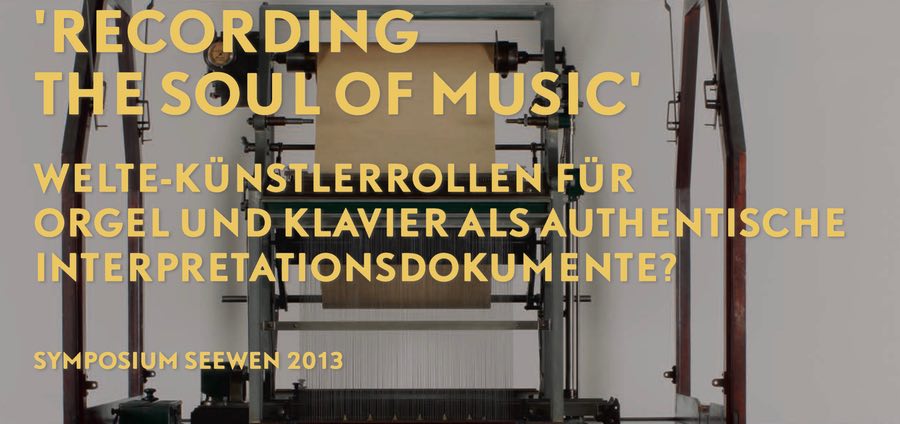
In research on Welte’s recording and playback technology, the work and findings of the “Institute Interpretation” at the Bern University of the Arts are outstanding. The documentation of the 2013 symposium (“Recording the soul of music”) offers many insights and is well worth reading! Since 2018, the Global Piano Roll Meetings (GPRM), a conference format founded by Marc Widuch, have brought experts from around the world together to continue researching and discovering.
Directory of Welte Rolls
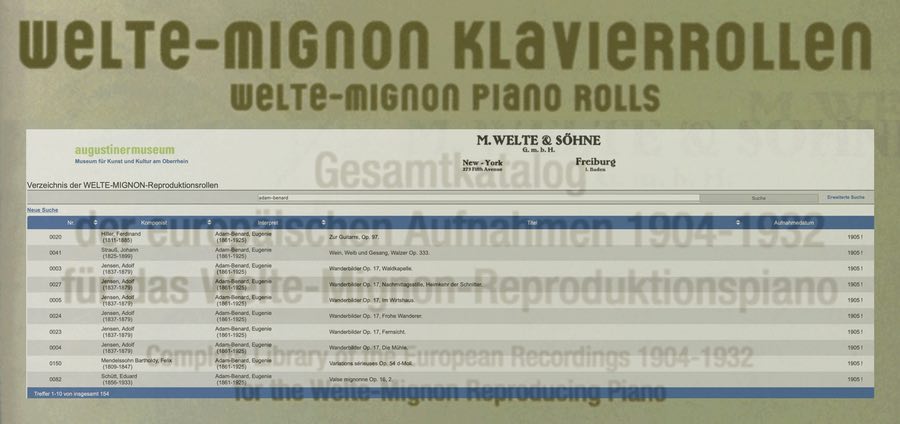
An impressive piece of work by Mr. Schmitz and Mr. Dangel resulted in the first complete catalog of Welte piano rolls. There is also an online database that lists all rolls and can be searched by composer, pianist, piece and more. We have compiled nearly complete roll lists for many other roll types, such as Hupfeld, Philipps, Empeco, etc., and can provide details on request.